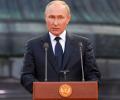
'When the war against Ukraine that Putin started is not going the way he was expecting it to and his military options are getting onerous, a bit of nuclear sabre rattling is what he hopes will turn things around for him and Russia.'

Pakistan needs to take practical steps to demonstrate that it is countering terrorist financing and extremists.

'It is astonishing that such a serious issue be handled in so casual and cavalier a fashion, but this has become what is expected of this government,' observes Aakar Patel.

The agenda of the talks will be to firm up a roadmap for disengagement of troops from all the friction points in eastern Ladakh, the sources said.

The bonhomie between Prime Minister Narendra Modi and Pakistan Prime Minister Nawaz Sharif seems to have also finally met its demise. Here's a look at their 'relationship'.
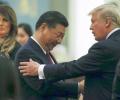
'While many Chinese policy makers dismiss the political, economic and technological component of US-India relations, they express caution on the defence-related ties which also happens to be a major driver in US-India relations,' explains China expert Srikanth Kondapalli.
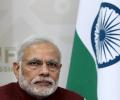
'There is nothing that Pakistan has done which deserves a resumption of dialogue. The assurances made in Ufa contain no commitment except a whole range of talks, which could take place without the paraphernalia associated with a joint statement of prime ministers.'

Prime Minister Narendra Modi had gone to China with a bagful of initiatives, but not all seems to have been fulfilled given China's reluctance to go the whole hog with him

Pakistan has informed India that it has appointed a new prosecutor to probe the 2008 Mumbai terror attack and will send a judicial commission to the country on September 23 to cross-examine witnesses in the case, meeting India's demand for progress in the investigations.

Earlier, Modi met Jinping seperately and the two leaders concurred there had been a perceptible improvement in bilateral relations.

Foreign ministry spokesperson Mao Ning went on the offensive saying "we do not believe the entry restriction measures some countries have taken against China are science-based".
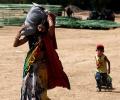
'Politicians's slogans on social distancing, showered like petals from their ivory towers, mock every single moment of pain and distress imposed on the vulnerable down below, at migrant labour stuffed like chickens on goods trucks, trying to get home at all costs,' observes Veenu Sandhu.

Xi's presence in Mahabalipuram is more of a political message by Modi to the world -- as well as to regional parties in South India that they should be beware of the BJP's rise, says R Rajagopalan.

'Significantly, Foreign Secretary Gokhale was received at very high level in Beijing.' 'It only shows China's keenness to move forward and put the relationship on a 'win-win' footing,' says Ambassador M K Bhadrakumar.
'The impasse on the India-China border in the Sikkim sector persists, but the Hamburg meeting between the two leaders will certainly have its salutary effects on the relationship between the two countries,' says China scholar Rup Narayan Das.

Prime Minister Narendra Modi will focus on extended neighbourhood, particularly the ASEAN and Central Asian regions, says Archis Mohan
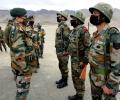
The seventh round of military talks between India and China held on Monday was "positive and constructive", and both sides agreed to earnestly implement the understanding reached by their leaders to not turn differences into disputes, a joint statement by the two armies said on Tuesday.
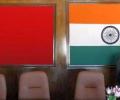
As the border standoff entered the sixth month, an early resolution to the row appeared dim with close to 100,000 Indian and Chinese troops remaining deployed in the high-altitude region and showing readiness for a long-haul. There is no official word on the talks yet but sources said the agenda was to finalise a roadmap for disengagement of troops from all the friction points.

The Wednesday talks took place amid a war of words between the two sides on perception of the LAC, the de-facto Sino-India border spanning a length of nearly 3,500 km.
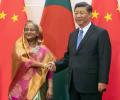
'Beijing is comfortable with Hasina's pragmatism -- perceived as 'pro-India', but staying out of Indian orbit and receptive to forging close ties with China and yet, siding with neither neighbour,' says Ambassador M K Bhadrakumar.

As India rises, creating niche areas for itself in the Asian landscape, China and India are bound to step on each other's vital areas of importance, says Srikanth Kondapalli.
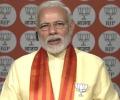
"Today the country is moving forward from women development to women-led development," Modi said.

Prime Minister Modi told President Xi that he has made efforts to improve ties with Islamabad but these efforts have been "derailed".

'From what evidence has come up, General Bajwa somehow managed to tell the Americans that I was anti-American.' 'And so, it [the plan to oust me] wasn't imported from there. It was exported from here to there.'
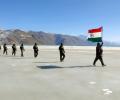
India has told China not to "shift goalposts" and "confuse" managing the border affairs and restoring peace at the frontiers with the larger issue of the resolution of the boundary question, which is dealt with by different designated mechanisms.

There are still a few lingering issues towards the progress of India-China bilateral relations, the approach for dealing with each other seems to be quite different. With Modi-Xi bonhomie strengthening, it seems that India and China are ready to recalibrate their approaches towards each other, says Sana Hashmi.
An MoU on sharing hydrological information of the Brahmaputra River by China to India and another pact on amendment of the protocol on phytosanitary requirements for exporting rice from India to China to include non-Basmati rice were signed after the Modi-Xi talks in the eastern Chinese port city.

China on Monday said India's membership bid in the NSG has become "more complicated" under the "new circumstances" as it again ruled out backing New Delhi's entry in the grouping, saying there should be non-discriminatory solution applicable to all non-NPT signatory countries.

A panel for informal consultations on India's membership has also been set up by the NSG and it will be headed by Argentine Ambassador Rafael Grossi.

'The Chinese are retaining geostrategic pressure on India by keeping troops there and building infrastructure continually.'

In diplomacy, a prime ministerial visit should be viewed as a rare event, not a routine one, which should be taken recourse to only when other options like ministerial visits are not available. But Modi has a different style of functioning. He wants to do everything himself, says Rajeev Sharma

President Xi said that the Chinese side is ready to work with the Indian side to carry forward the fresh impetus of bilateral relations.

The stand by China spelt out by its foreign ministry insisting that it takes the 1959 line on perception of the LAC amid a nearly five-month-long border standoff in eastern Ladakh triggered a strong reaction from India.

All the three issues raised by China at the Modi-Xi meeting are either intractable or peripheral to the bilateral relations and suggest conventional methods to placate the other side without yielding much, says Srikanth Kondapalli.
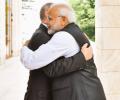
Modi said India and Russia have been friends for a long time and thanked Putin for inviting him for the first-ever informal meeting at Sochi.

Terrorism and Afghanistan were the focus points of Prime Minister Narendra Modi's talks with Uzbek President Islam Karimov on his first visit to Central Asia.
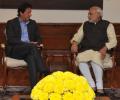
'The ceremony on May 30 is all about Modi and there is the great risk that Imran Khan who is a rockstar among Indians might end up stealing the show,' says Ambassador M K Bhadrakumar.
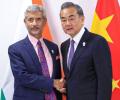
The joint statement said Jaishankar and Wang agreed that both sides should take guidance from the series of consensus reached between leaders of the two countries on developing India-China relations, including not allowing differences to become disputes.

By jettisoning the vision of multilateral world in favour of a Han Empire, China has posed a major long term challenge to India. India must stand firm against Chinese expansionism but also keep a door open for future detente by making a clear distinction between Chinese people and the current Chinese leadership, observe Lieutenant General Ashok Joshi (Retd) and Colonel Anil Athale (Retd).
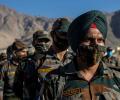
The decisions were mentioned in a joint statement issued by the two armies late Tuesday, a day after the sixth round of Sino-India Corps commander-level talks that lasted for 14-hours.
